The choice between providing and being present, and the family bond we build in the hours we’re given.
Familial bonds are one of the core themes woven through Sera, Lily & The Fox Prince—not only between the two sisters, but through their mother, too. Even in the dark Netherwood, she is with them. In the lessons she taught. In the boundaries she held with gentleness. In the internal voice she helped shape inside her daughters.
I wrote that relationship the way I hope to shape my own children.
But I haven’t always been this version of myself.
I became a mother at seventeen—young, independent, still wrapped up in the shallow worries of high school, and then suddenly confronted with a sacred new reality: someone else needed me. It brought me back to my center. It taught me what love asks of us.
And then life demanded trade-offs.
In the years that followed—through instability, a rocky first marriage, and the weight of being the provider—I entered the workforce and slowly fell prey to the corporate machine. Long days. Early drop-offs. Late pickups. Minutes together in the morning. An hour at night. Weekends filled with adventures meant to “make up for it.”
But the truth is: when you’re gone that much, other people begin shaping your children’s inner world more than you do.
The pandemic brought us home—and it showed me, with aching clarity, what presence actually does. It gave me the chance to relearn my children, to rebuild connection in the daily, and to rewrite the voices in their heads with kindness, steadiness, and truth.
This week’s full Letters from the Netherwood letter goes deeper into that story—how familial bonds are built, what absence costs, and why so many parents are forced to choose between providing and being present.
Question for you: Have you ever had to choose between providing and being present—and what’s one small way you protect your family bond this week inside the life you actually have?
Content note: the full letter includes references to relational instability and abuse. Please read gently.
The future is unwritten, and each of us holds an author’s quill.
We are at a moment of great moral conscience and consequence.
Collectively, we stand at a precipice. A fracture. A divide. Somewhere between where we’ve been living for decades and where we will go from here. The next chapter is not something that simply happens to us. It is something we are choosing—decision by decision, day by day—with our hands still on the pen.
And I can’t stop thinking about the contradiction we are sold.
We’re told that one little choice doesn’t matter, that one person cannot shape the future. Yet in this same reality, we are also sold the opposite lie—that one person can single-handedly change the trajectory of the world order.
Both cannot be true.
The moments we choose matter. They shape our own world first, and then the interconnected world of our relationships, our neighborhoods, our communities. Most of the time, those ripples travel farther than we ever get to witness.
This weekend has made that truth feel painfully visible. Reports from Tehran describe fuel depots struck and burning, toxic smoke blanketing the city, and rain turning black and acidic as soot and chemicals fall back down.
It is a reminder that our headlines are not abstract. They land on bodies. On lungs. On children. On the air.
Which brings me back to the point:
Change starts small, and in the quiet places no one sees. In the moments where you choose to be intentional instead of automated.
Trust is one of the deepest themes woven into Sera, Lily, & The Fox Prince. Not as a soft idea, but as a backbone. As an invisible thread that holds when fear gets loud, and doubt tries to speak in a voice that sounds like your own.
I didn’t realize how personal that theme was for me in my youth through my early twenties.
There was a season in my life when I trusted with all of myself—open, full-bodied trust that didn’t keep a tally. And then, little by little, trust began to fracture. My parents divorced but remained close for a time… until a new influence entered the picture and relationships shifted in ways that changed the shape of my world. Later, in my early twenties, I found myself in a marriage where self-sacrifice was not romance—it was survival. If you want more of that context, it lives in my Wild-hearted Bravery letter.
After enough breaks, I developed certain “truths” that were really just protection in disguise:
Everyone will let me down eventually. Trust nobody. Enjoy it while you can… until the other shoe drops.
That “other shoe” became an inevitability I carried—armor that felt like wisdom.
But therapy, time, and healing love have taught me something different: trust can be rebuilt. Not blindly. Not perfectly. But humanly—through repair, understanding, and the steady proof of someone who continues to show up.
This is the fervent kind of trust I wrote into the heart of the Netherwood. It is the kind that holds even when fear arrives wearing a familiar face.
A Milestone for Sera, Lily & The Fox Prince has been reached!
Today I am sharing an accomplishment that I honestly had not even considered before it happened.
On February 26, 2026, Sera, Lily & The Fox Prince was named #1 New Release in Classic Coming-of-Age Fiction on Amazon!
I am so deeply grateful. This is a celebration that I am holding onto for the moment is the direct result of craft, leadership, and identity.
Craft is the quiet part that people don’t always see. It’s the countless revisions. The belaboring over each and every punctuation. It’s learning to uncover the magic of what your story is actually about and having the courage to rewrite it until it finally matches the feeling in your chest you want to emulate.
Leadership, in the indie author world, often looks like leading yourself. Choosing consistency and learning how to be disciplined. Creating the structure behind creating and keeping to imaginary deadlines where no one else is holding you accountable. Holding to those standards even when you’re bone tired.
Identity is what remains when the excitement wears off. The sentence you return to when you’re not sure that you are supposed to be doing this. I am a writer. I finish what I start. I create worlds.
If you’re new here, Sera, Lily & The Fox Prince is a YA fantasy about two sisters, a forbidden forest, and the kind of courage I call wild-hearted bravery—the bravery that shows up while your hands are still trembling.
If you want the story behind the story, the real-time journey, the world-building, and the quiet truths that built this book—come join Letters from the Netherwood on my Substack.
Thank you for being here. Thank you for believing in this world. The Netherwood is calling—and today, I’m answering back, and I wish you would join me too.
This is a note for anyone who’s ever felt they had to compartmentalize themselves to be accepted.
A reminder I’m carrying with me as I write and share this journey: you are who you are—every part of you.
Today I am going to write something even more personal from me to you because I think someone out there needs permission to stop splitting themselves into pieces.
After reading yesterday’s post, you might be wondering:
“What on Earth could she be sharing today, considering her previous post?”
Well, for a long time, I believed I had to present myself in pieces, depending on the room and who was in it with me.
There was the professional version for certain spaces.
The creative for private hours.
The spiritual kept soft, quiet, tucked away like something too tender to carry out loud.
I am choosing to write this here, because maybe, just maybe, you know that feeling too.
Like you have to edit yourself down to what’s easiest to understand. Like your joy needs a label, to be understood by others, to be valid and accepted in that room you are in. Like your depth needs to be toned down so it doesn’t make anyone uncomfortable.
But here’s what I have learned–slowly, and sometimes the hard way:
We are not meant to be split.
We are not meant to be sorted into neat categories or compressed into one “acceptable” identity. You can be intelligent and imaginative at the very same time, and one does not detract from the other; it actually enhances it.
You can be grounded and whimsical.
You can be logical and deeply feeling.
You can be ambitious and devoted.
You can love structure and still crave mystery.
You can be all of it, every single piece, even when it doesn’t “make sense” to others. I think it is because somewhere along the timeline, we were taught to be neat. Categorized. Easier to place. Easier to collect, even.
And when you challenge that narrative of old, when you stop apologizing for your complexity, well, something beautiful happens.
Your life starts to feel like it belongs to you again.
That’s what I hope this space becomes– a soft space to land for the parts of you that don’t fit into just one box. A reminder that integration isn’t messy or confusing…it’s powerful! It’s the most honest kind of strength and bravery.
It is also how this story came to be. This story holds the parts of me I used to keep separate.
Sera, Lily & The Fox Prince is a portal, yes…but it’s also a mirror. It holds the themes I return to again and again: trust, courage, friendship, the ache of winter, the pull of the unknown…and the quiet, steady truth that love isn’t always loud, but it is always real.
If you’ve ever felt pulled between who you are and who you’re “supposed” to be, this story was written for you, too.
So if you’ve ever felt like you had to shrink yourself to be understood…
This is your reminder:
You are who you are–every part of you.
The most powerful lives are integrated ones.
And the most meaningful work is the kind that stays true across every room you walk into.
Welcome to the adventure that I call mine.
Leave a comment below if you are brave enough, tell me: “Where have you had to split yourself–work, creativity, faith, parenthood, relationships?”
I’ve always been the kind of person who flinches at the first real cold snap. I count the days until the sun feels warm again. I treat January and February like something to endure rather than live inside of. Which is funny, in a way, considering I live in New England.
I chose this. I built a life here.
I know the rules: the gray, wintry skies, that gust of wind that just happens to find each and every seam in your coat, the way your bones feel the weather before your phone does.
And still… every year, winter arrives, and I brace for it like an argument I didn’t ask to have.
But this year, I made a decision.
Not a dramatic, cinematic one—just a quiet vow I kept repeating to myself each time I felt the dread of the coldness of winter.
I’m trying to fall in love with winter.
The goal is not tolerate it. Not “make the best of it.” Not grit my teeth through it and reward myself later with spring.
Fall in love.
I wanted to stop treating the cold like an enemy and start treating it like a teacher. It should be like a season that belongs in the story of my life, instead of a long footnote between the chapters I actually enjoy.
And winter, being winter, immediately tested me.
We’ve had more snow this year than I can ever remember. Snow didn’t simply fall and melt politely in a day or two this season as it always has in the past. Instead, it piled and stayed. At one point, it felt like the world had narrowed to white and silence. Even now, there’s nearly two feet still on the ground, as if the earth itself is refusing to let go.
It’s been the kind of winter that makes you understand why people used to fear it.
The kind of winter that makes you wonder if spring will ever arrive again.
And yet—this is the strange part—something in me has softened.
Not fully. I’m not out here claiming I’ve become a winter person overnight, the kind who thrills at icy mornings. Though… I do have to admit that two pairs of nice wool socks are a game-changer!
But I have almost stopped despising it.
Almost.
And I didn’t expect the thing that would help me get there would be… my own book.
The Unexpected Gift of Returning to My Story
Lately, I’ve been rereading Sera, Lily & The Fox Prince.
There’s a particular kind of vulnerability that comes with returning to something you made. When you’re drafting, you’re inside the work. You’re too close to it. You’re solving problems, shaping scenes, worrying about pacing and proofing, and the thousand tiny choices that make a world feel real.
But when you reread it later, something changes.
You become a reader again.
And suddenly you’re seeing the world through your characters’ eyes—through Lily’s quiet steadiness, through Sera’s fierce warmth, through the way the forest breathes and watches and holds its secrets. Through my two daughters’ eyes.
You remember not only what you wrote, but why you wrote it.
And as I reread, I realized how much winter lives inside the book—not just as weather, but as metaphor.
Winter in my story isn’t only cold. It’s a mood. A threshold. A proving ground.
It’s the season that asks you whether you can keep your goodness when everything feels hard.
Whether you can stay grateful when you are tired of being brave.
Whether you can keep your love intact when the world tries to shrink it into survival.
There’s a line in the book that has been echoing in my mind as the snow keeps lingering outside my windows:
“Perhaps Winter is only lingering to see if we will still be grateful when Spring arrives.”
When I wrote that, I knew it was true for the characters. I didn’t realize it would become true for me.
Seeing Winter Through My Daughters’ Eyes
Here’s the real truth underneath all of this: I wrote this book for my children.
My daughters, especially.
I wanted them to have a story that felt like a lantern. Something brave and tender. Something that reminds them that strength doesn’t always look like shouting—it can look like staying kind. Staying connected. Staying steady. Choosing good in a world full of temptation and distraction.
And rereading the book now, in the middle of a relentless New England winter, I keep thinking about what they would notice.
Children don’t look at winter the way adults do. Adults measure winter by its inconveniences: shoveling, icy roads, canceled plans, brutal cold.
Kids measure winter in magic.
They notice the hush that comes after snowfall, the way everything looks freshly remade. They notice the sparkle on branches. They notice how sound changes. They notice the way the world becomes a giant blank page.
Even when they complain about it, they still feel the wonder.
And somehow, rereading my own work has helped me borrow their eyes again.
It has helped me see winter not only as something to survive an endure for a few months, but as something that holds beauty. Beauty that you can’t access in any other season.
Winter has its own language. It speaks in quiet, in endurance, in small lights.
Falling in Love Doesn’t Mean Pretending It’s Easy
I used to think that if I couldn’t enjoy winter, it meant I was failing at gratitude. That I needed to move somewhere warm and tropical so I could enjoy the whole year.
But I don’t believe that so much anymore.
Trying to fall in love with winter doesn’t mean I have to pretend the cold isn’t hard. It doesn’t mean I have to romanticize exhaustion or ignore the heaviness that can come with long stretches of gray.
It means I’m learning to stop fighting reality.
It means I’m learning to ask: What is winter offering me, if I’m willing to receive it?
Some days, the answer is simple.
It offers me permission to slow down.
It offers me the quiet I keep claiming I want.
It reminds me that rest is not laziness.
It offers me the truth that warmth feels warmer when you’ve known cold.
And lately, it has offered me something else too, the strange, humbling experience of being comforted by my own words. Because I wrote them for a reason, and now I need them as well.
Almost There
I’m not fully in love with winter yet.
But I’m closer than I’ve ever been.
I’ve stopped glaring at the snow like it’s personally insulting me. I’ve started noticing the beauty in the way it collects on branches. I have fallen back in love with the magic of icicles. I’ve started lighting more fires to enjoy the coziness of it, rather than as an extra source of heat.
I’ve started rereading the passages that feel like they were written to carry someone through.
And sometimes, when I look out the window and see that the snow is still there—still deep, still bright, still refusing to leave—I don’t feel dread.
I feel something gentler.
I feel the smallest, most surprising flicker of affection. I see my daughters playing out in the snow and sense the magic they feel of the world being transformed before their very eyes. The way that you can see something so familiar transform into something anew.
Maybe winter is lingering to see if I’ll still be grateful when spring arrives.
Maybe winter is lingering to teach me how to be grateful before it does.
Either way, I’m listening.
And for the first time in a long time, I’m not only counting down the days until spring.
I’m learning how to live inside the season I’m in.
If you are also trying to make peace with winter, I shared a companion reflection on Science with Sabrina.
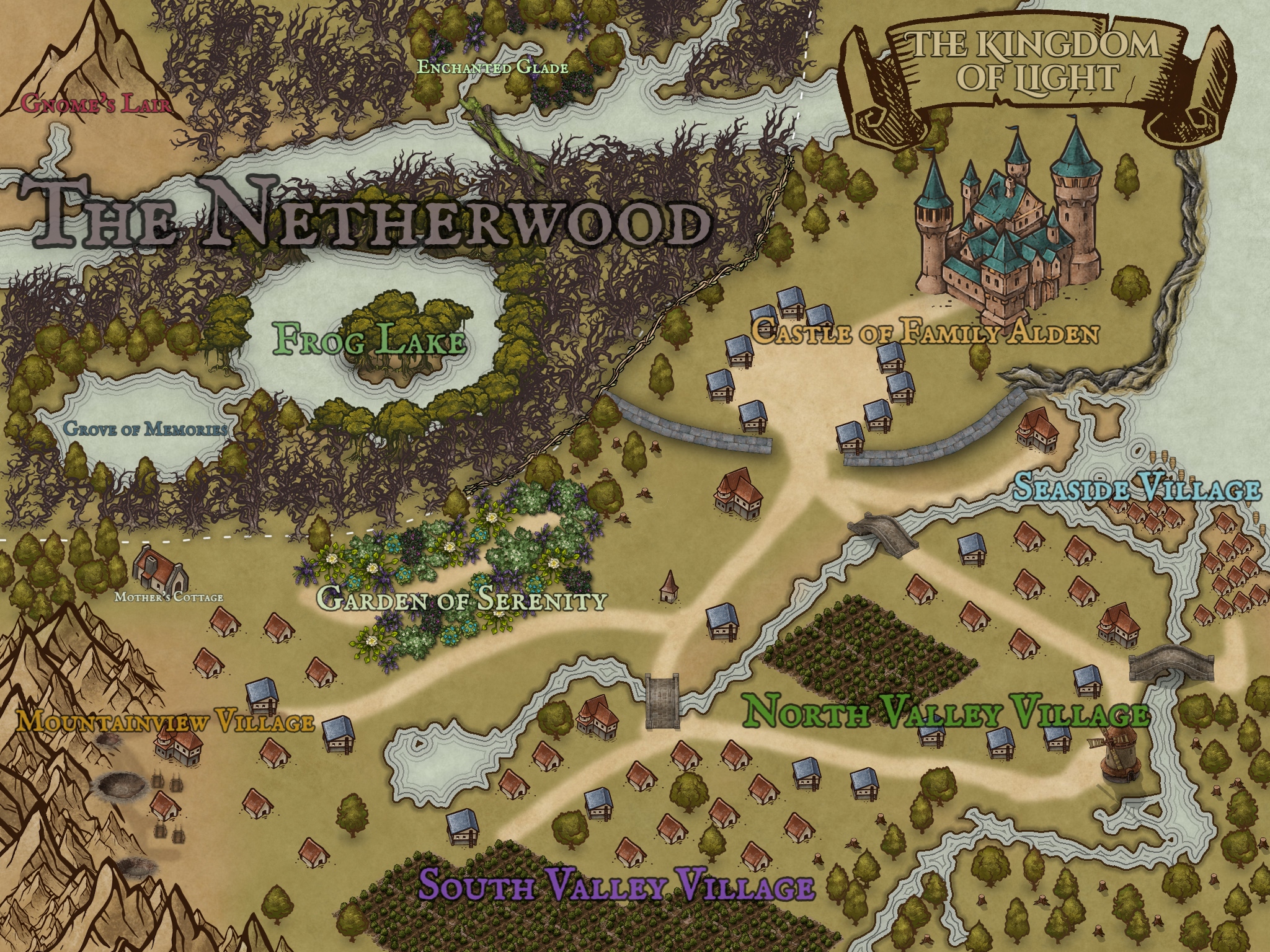
Today I get to share something I’ve been dreaming about for a long time. It is the official map of The Kingdom of Light. This is the primary kingdom in my debut YA fantasy novel, Sera, Lily & The Fox Prince.
If you love fantasy stories that feel like stepping into a living world, you already understand why this matters. Every road hints at a choice, and every border suggests danger. A map isn’t just decoration.
It’s a promise:
This world is real enough to get lost in.
Why “The Kingdom of Light”?
In the story, the Kingdom of Light represents what is known. What is structured, named, and understood. It’s the realm where the rules make sense… before the Netherwood begins to challenge what the characters think is true.
Behind the Scenes: How I Built the Map
Whenever I design anything for this book, I first consider one question.
Does this make the story feel more immersive?
So while creating the Kingdom of Light map, I focused on:
It is easy to read
The travel logic makes sense
It helps to built character to pair well with the story
It creates a sense of wonder, because who doesn’t like the surprise of getting sucked into a separate world?
I wanted it to feel like something you might find tucked inside an old book. I thought that it should be inked with intention and filled with quiet clues.
The Kingdom of Light Map
The Kingdom of Light from YA Fantasy Novel Sera, Lily & The Fox Prince
What’s Next?
This is the first of several world-building reveals I’ll be sharing. The Kingdom of Light is only the beginning… and as you can see, the Netherwood is always near.
If you’d like to see more map details, leave a comment. Alternatively, you can send me a message.
I love hearing what readers are curious about. If you want a future post breaking down landmarks without spoilers, let me know.
Here are my questions for you:
Does anything feel confusing or hard to read at first glance?
What’s the first place your eyes go?
Does it make you curious about the story?
Welcome to the Kingdom of Light. And if you’re brave enough… welcome to the Netherwood.